
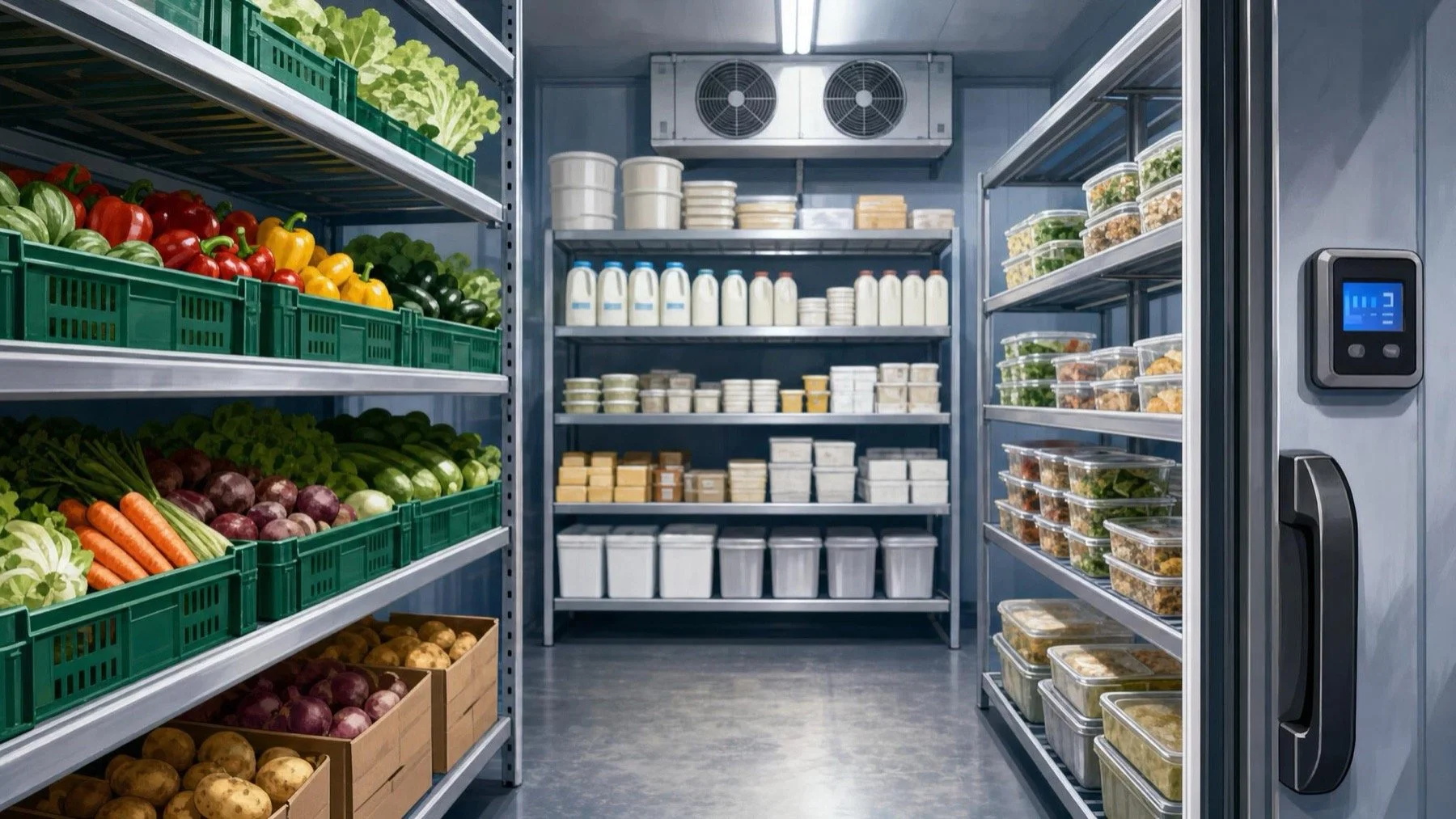
There is no single correct cold room temperature for a room that holds mixed product. Let the least tolerant product set the number, judge the room by its recovery after deliveries, and split the room when products need clearly different conditions. That is easy to say when one product fills the room. It gets harder when a grocer or caterer keeps produce, dairy, beverages and prepared food behind the same door. We spec the refrigeration system to the exact product and volume requirements of each room, which is why the product list comes before the drawing. This article explains how to choose the number for a mixed room, why recovery matters as much as the setpoint, and when it is better to split the room than to compromise.
What cooler and freezer bands usually mean
The broad categories are simple. As general guidance, NRCan describes walk in refrigerators as operating above 0°C and at or below 13°C, and walk in freezers as operating at or below 0°C. That wide cooler band covers very different jobs, from a cool room for wine or flowers to a cold room for meat and dairy.
In food service, the working range is narrower. In our builds, coolers hold product at 35 to 40°F for fresh storage. Freezers hold at 0°F or below for frozen product. Your local public health requirements set the limits for food that must be kept cold, and this article is about the choices you make inside those limits.
Let the least tolerant product set the number
In a mixed room, start by listing every product group and the temperature range its supplier or your food safety plan calls for. Then look for the overlap. The setpoint has to sit inside the range of the product with the least tolerance, and the products at the edges of that range need the most attention. Some stock also cares about humidity and air movement as much as temperature, which a single setpoint cannot fix. When the ranges overlap comfortably, the choice is simple. When they do not, someone has to decide which product the room is built for.
That decision is a business one as much as a technical one. A florist judges a cooler by how long stems last, and our florist cooler page shows how different that room is from one built for meat. A grocer might accept a compromise for back stock that turns over in two days but not for product that sits for a week. Write the choice down, because it becomes the design temperature the refrigeration is sized for.
Recovery after a delivery matters as much as the setpoint
A room that sits on its setpoint overnight can still treat product badly if it takes hours to recover after a delivery. Warm cases, an open door and staff moving in and out all add heat at once, and the refrigeration has to remove it. Refrigeration sizing has to account for box volume, insulation, door traffic, product load and how hot the summer gets. If those inputs were underestimated, the room may hold its number on a quiet Tuesday and drift every delivery morning.
Practical habits help any room recover. Receive and put away in one push rather than leaving the door propped, keep warm product off the shelves nearest the coil until it has cooled, and avoid loading cases tight against the coil face. Each habit takes load off the refrigeration on the mornings that matter most.
Split the room or compromise the setpoint
| Option | When it fits | What to weigh |
|---|---|---|
| One room, one setpoint | Products share a range and turn over quickly | Simplest to build and run. The least tolerant product decides the number. |
| One room with zones | Small differences, such as keeping sensitive stock away from the coil | Easy to set up, but zones can drift with loading and airflow. |
| Two rooms or a divided room | Products need clearly different temperatures or humidity | More doors and more refrigeration, but each product gets its own conditions. |
| Cooler and freezer combination | Fresh and frozen stock arrive and leave together | Shared envelope and layout, with separate temperatures behind separate doors. |
Splitting costs more at the start, so the product should justify it. When it is justified, each room can be designed for its own job. Our custom walk in coolers in Toronto are planned around the products you store, and a combined cooler and freezer build is an option where fresh and frozen stock move together.
Operator's refrigeration decision: pick the product the room is built for
A mixed room works when one product is clearly allowed to set the temperature and the others are comfortable with that choice. If you find yourself arguing about the setpoint every season, the room is probably serving two jobs, and it may be time to separate them. Beyond Toronto, we cover Mississauga, Brampton, Vaughan, Markham, Oakville, Burlington, Hamilton and Barrie. Operators in Mississauga can start with our Mississauga cold room page.