
How Much Power Does a Walk-In Cooler Use?
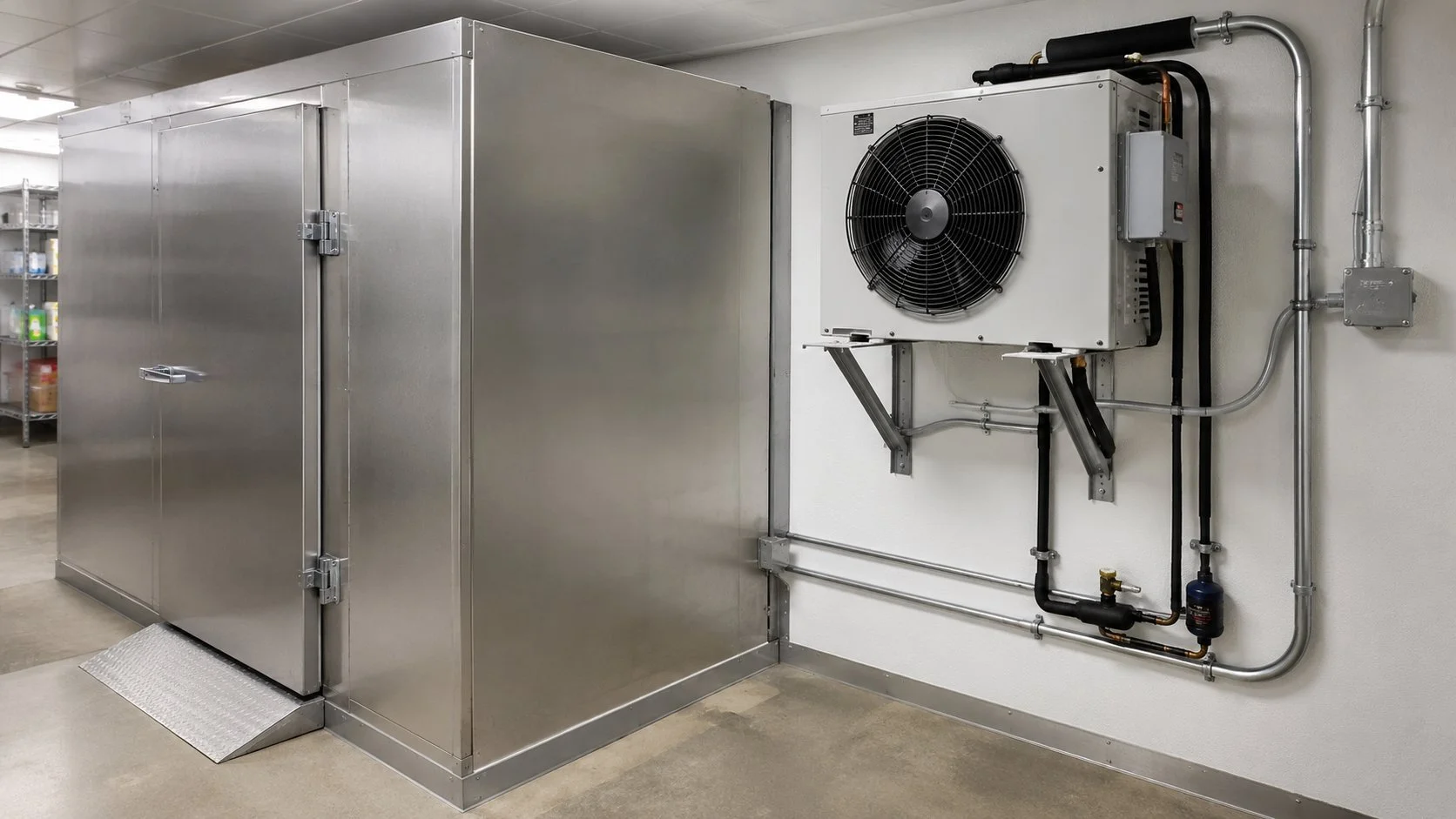
Every walk-in cooler owner eventually asks the same question, usually while holding a hydro bill. How much of this is the cooler?
There is no single number, and anyone who gives you one without seeing your room is guessing. Two coolers with the same footprint can pull very different amounts of power. What you can know is exactly what drives the number, how to measure yours, and which build choices push it down for the life of the unit.
What actually drives a cooler's power use
A walk-in cooler uses energy to move heat out of the room. Everything that adds heat, or lets it back in, adds to the bill.
The main drivers are the size of the room, the temperature it holds, the quality and thickness of the insulation, how well the room is sealed, how often the door opens, how warm the product goes in, the ambient temperature around the unit, and the condition and sizing of the refrigeration system.
A freezer works harder than a cooler because it holds a much bigger temperature difference. A unit next to a cooking line works harder than one in a cool basement. A room loaded with warm deliveries works harder than one receiving pre-chilled stock.
Why two identical rooms pull different power
Take two rooms with the same dimensions. One has thick, tightly sealed panels, a properly sized system, and a door that closes itself. The other leaks at the seams, runs an oversized compressor that short cycles, and has a door that staff prop open during deliveries. The second room can use a multiple of the first room's energy, every day, forever. The footprint did not decide the bill. The build did.
How to find your own number
Skip the generic charts. Your cooler's real consumption is measurable. The simplest route is a plug-in or clamp-on energy meter on the refrigeration circuit for a full week, covering deliveries, rushes, and weekend lulls. Divide by seven and you have your real daily kWh. Multiply by your hydro rate and the number stops being a mystery.
Measure in summer and winter if you can. The difference between the two readings tells you how much ambient heat is costing you, which is useful when you decide where a new unit should sit.
Reading the signs without a meter
Even without measuring, the room tells you things. A compressor that rarely stops, ice forming at seams or around the door, condensation on walls, and temperatures that sag on hot afternoons all point to energy being wasted. Each one is a fixable build issue.
The build choices that cut power use for years
Energy cost is mostly decided on install day. The room's panels and insulation set how fast heat gets back in. Tight cam lock panel seams stop the leaks that run compressors around the clock. Right-sized refrigeration, matched to the room and its door traffic at a professional installation, avoids both the always-running undersized system and the short-cycling oversized one. Good door hardware, sweeps, and strip curtains protect the cold during busy hours.
Placement matters too. Every degree cooler the air around your condensing unit runs, the less work it does. We covered the operating habits that help in our energy efficiency guide.
When high power use is telling you something
If your cooler's consumption keeps climbing year over year, the room is talking to you. Seals age, insulation gets damaged, refrigeration drifts out of spec. Sometimes a tune-up restores it. Sometimes the honest answer is that an old, leaky room costs more to run than a new build would, and the hydro bill is quietly funding the difference every month. That crossover is worth calculating before the next bill, not after.
FAQ
How many kWh does a walk-in cooler use per day?
It depends on size, temperature, insulation, sealing, door traffic, and ambient heat, which is why generic numbers mislead. Metering your own refrigeration circuit for a week gives you the real figure for your room.
Why is my walk-in cooler using so much electricity?
The usual suspects: leaking seams, worn door seals, an aging or mis-sized refrigeration system, warm ambient placement, or doors held open during service. Each shows up as a compressor that rarely rests.
Does a walk-in freezer use more power than a cooler?
Yes. A freezer holds a much larger temperature difference, so it needs thicker insulation and works harder. That is also why freezer builds are specced differently from day one.
How can I lower my walk-in cooler's energy cost?
Fix the seal, service the door hardware, keep the condenser area cool and ventilated, load pre-chilled product where possible, and keep the refrigeration maintained. For older rooms, compare the running cost against a modern, tightly built replacement.
Does insulation thickness really change the bill?
Yes. Insulation and sealing determine how fast heat re-enters the room, which is the work your compressor pays for. A well-insulated, tightly sealed room runs a fraction of the compressor hours of a leaky one.
Can Titan help me plan an efficient build?
Yes. We design, build, and install walk-in coolers and freezers with the insulation, sealing, and right-sized refrigeration that keep operating costs down. Ask us to scope it for your space.
Want a cooler that is cheap to run, not just cheap to buy? Titan builds and installs efficient walk-in coolers and freezers across Toronto, the GTA, and Southern Ontario, 500+ installs since 2013. Request a free quote or call (416) 896-7153.