
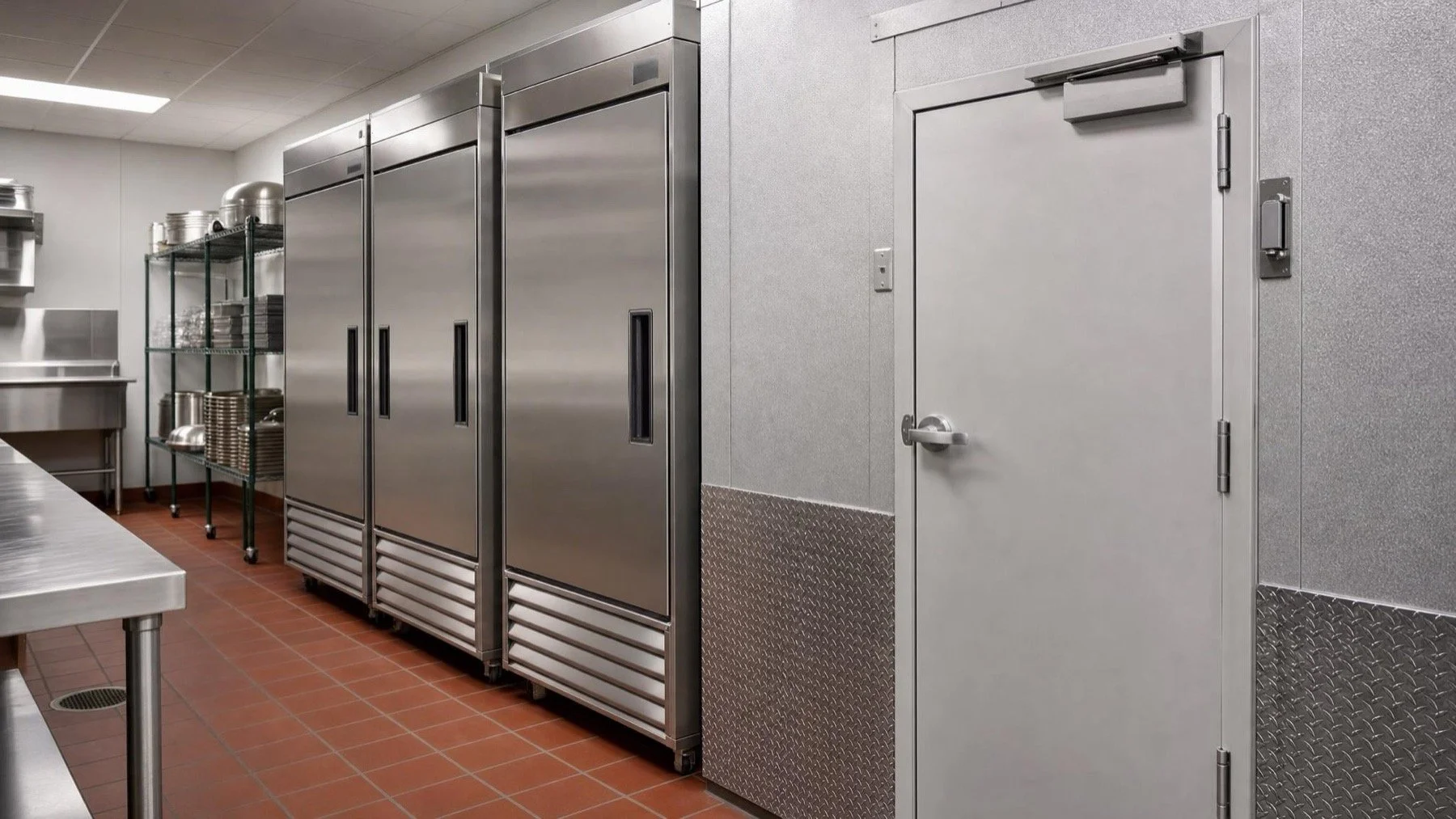
How many upright units can one kitchen line up before the layout stops working? Many operations add a commercial freezer at a time, each one solving that month's capacity problem. After a few years the back of house has four or five doors to open, stock split across them and compressors pushing heat into a room that is already hot. This article helps you recognize when a row of reach in units has become the wrong tool, and what a walk in freezer would add to your building if you make the switch.
Signs the reach in line has stopped working
None of these signs proves on its own that you need a walk in. Together, they usually mean your frozen capacity is spread across too many boxes.
- Staff open two or three units to find one product, because stock is stored wherever there was room.
- Delivery day means rearranging every unit and stacking overflow in a chest freezer down the hall.
- The units sit in the kitchen or a corridor, and the space around them is warm and noisy during service.
- Door seals and hinges wear quickly because each unit is opened again and again through the day.
- Ordering is limited by what fits rather than by what makes sense to buy.
If three or more of those apply, the question is less about buying another box and more about whether the stock belongs in one room.
Count the door openings, not only the cubic feet
Comparing total volume is the usual starting point, but it misses how the stock is used. Each upright unit loses cold air every time its door opens, and a line of them in a busy kitchen is opened constantly during service. A walk in puts the stock behind one door, so staff can pull everything they need for a prep session in one trip. That only works if the room is laid out well, which is why the shelving and the position of the door are part of the decision rather than an afterthought.
Heat is the other difference. Every reach in unit has its own compressor releasing heat into the room around it. In a walk in, NRCan guidance describes the compressor as usually mounted outside the room, and it can be located away from the kitchen altogether. That can make the kitchen more comfortable and gives the refrigeration a steadier place to work. Our comparison of indoor and outdoor condensing units explains how that location is chosen.
What a walk in freezer adds to the building
A walk in freezer is a building project as well as a purchase, and some of its parts have no equivalent in a reach in unit. The floor is the first. Every Titan freezer includes electric heat tape under its insulated floor panels to keep the sub floor at a stable temperature. The door is the second. Our freezer doors use a heated perimeter, anti sweat wire and a safety release so they do not freeze shut.
The site has to support those parts. Before quoting, our site survey measures the space, confirms electrical capacity and condensate drainage, and flags any access challenges for the freezer package. A kitchen that already struggles for power may need electrical work, and the electrical requirements guide lists what to check. If you are weighing a packaged unit against a room built to fit, our article on custom and standard walk in freezers compares the two.
Operator's refrigeration decision: plan the switch around a quiet week
The move from reach in units to a walk in is easiest when it is planned around the calendar. Pick a slower week, decide which units will stay on the line for daily use and which will be sold or moved, and plan where stock will sit while the room is installed. Most of our restaurant scale freezer builds install in one to two days. Confirm the timing for your own site, since access and electrical work can change it.
Many kitchens keep one or two reach in units at the line for the items cooks need within arm's length, and move bulk and backup stock into the walk in. Our custom walk in freezer rooms can be sized around that split. We offer custom freezer builds and installation for kitchens and food businesses across Southern Ontario, including Toronto and the GTA. Restaurant operators can see typical layouts on our restaurant cooler and freezer page for Toronto.