
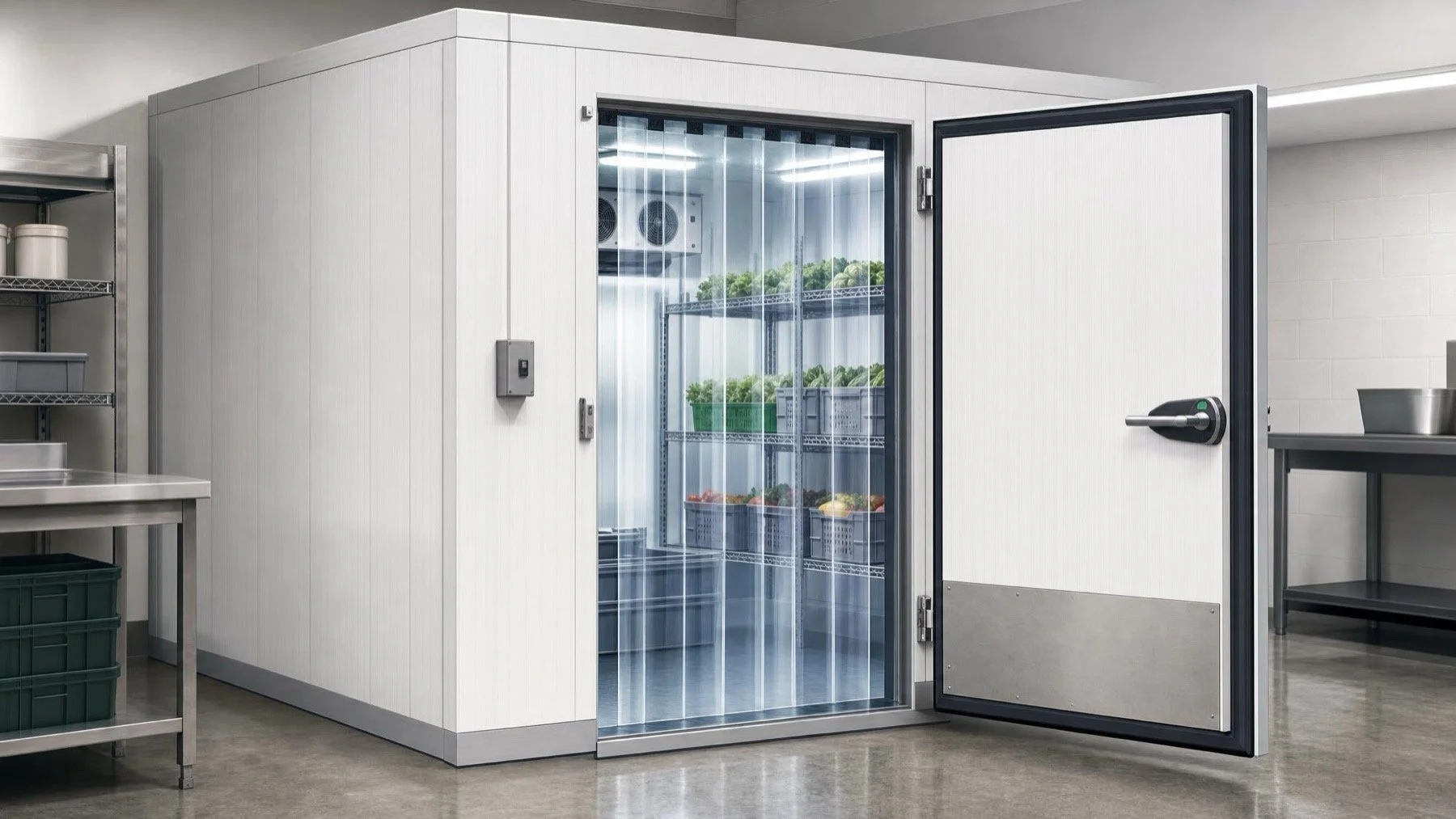
If you are comparing walk in cooler Canada listings online, many of them lead with box size and price. Fewer explain that walk in cooler and freezer components sold here fall under federal energy efficiency rules, or what that means for a room in an Ontario kitchen, grocery or warehouse. This guide sets out what NRCan says the rules reach, which efficiency features its guidance points buyers toward, and which questions to ask before you choose between a listed package and a room designed for your site.
What the federal rules reach
According to NRCan guidance, walk in freezer and walk in cooler components are subject to Canada's Energy Efficiency Regulations, which set a minimum standard for their energy efficiency. The detail sits in the regulations and in NRCan's guide to them. For a buyer, the practical point is that efficiency is regulated at the level of the parts that make up the room, so it is worth asking how each part in a package meets the rules.
That has two consequences. First, a box listed online is only part of the picture. The panels, the doors and the refrigeration system each have their own role, and a package price may or may not include all of them. Second, a regulation sets a floor rather than a target. A room can meet the minimum and still be poorly suited to your door traffic, your product or your summer temperatures. Efficiency in daily use comes from the components and from how the room is designed and installed.
How a typical room moves heat
NRCan describes the usual arrangement in simple terms. An evaporator coil inside the room absorbs heat, the refrigerant carries it to a compressor and condenser, and NRCan notes that the heat may be expelled into the building, outdoors, or into cooling water. Where that heat goes affects your energy use as well as your kitchen. Heat rejected indoors adds to the load on the building in summer, while heat rejected outdoors needs equipment that can cope with Ontario winters.
This is where design choices matter more than the label on any single part. A condensing unit sized for the real load runs steadily. One that is too small runs almost constantly, and one that is far too large can cycle on and off in short bursts. Our article on remote and self contained refrigeration covers how the location of that equipment is chosen.
Features NRCan points buyers toward
NRCan's buying guidance goes beyond the minimum standard and lists options that reduce the heat a room gains and the energy it uses. Not all of them suit every room, but they make a useful checklist when you compare suppliers.
- Better insulation in walls, ceiling and floor can reduce the heat that leaks into the room, according to NRCan guidance.
- NRCan guidance says better gaskets and sealing materials for doors can reduce energy use.
- Occupancy sensors that turn inside lights on only when a person is present can cut lighting hours in a room staff enter all day.
- Air curtains, especially recirculating models, and even strip curtains appear in the same guidance as ways to reduce the warm air entering at the door.
- NRCan also points to air and water infiltration sensors that can monitor the condition of insulation.
- Higher efficiency compressors and improved evaporator and condenser coils are listed as technologies that can lower energy use.
Some of these are design decisions, such as insulation and the door arrangement. Others are operating decisions, such as whether staff will use a strip curtain properly or whether anyone will check the readings from an infiltration sensor. A feature only saves energy if it fits the way the room is used.
Questions to put to any supplier listing
A listing that shows a box, a size and a price leaves most of the efficiency story untold. Before you buy, ask:
- Which components are included: panels, floor, door, refrigeration system, controls and lighting?
- How does each regulated component meet the federal minimum, and can the supplier show it?
- Was the refrigeration sized for this room, its door traffic and its location, or is it a standard pairing?
- Where will the condensing unit sit, and will it run through an Ontario winter if it is outdoors?
- Who installs the room, seals the panel joints and commissions the system?
- What does the price leave out, such as electrical work, drainage, removal of an old room or site access?
The answers often reveal that two similar looking listings describe very different rooms. A lower price can mean a smaller refrigeration package, a floor that is not included or installation left to the buyer. Our Toronto walk in cooler cost guide walks through the factors that shape a full project price without quoting figures.
Where a room designed for your site fits
Packaged rooms suit some sites well, particularly where the space is a standard shape and the use is simple. Rooms with awkward footprints, heavy door traffic, mixed products or outdoor locations tend to benefit from design. Efficiency comes into that design from several directions at once. On our warehousing builds, refrigeration sized to the real load, insulated panels and tight vapour sealing are how we cut runtime. Our standard cooler lighting is sealed, low heat and 5000K neutral white, with an occupancy switch available as an option, which ties directly to the occupancy sensors NRCan lists.
Installation matters as much as the parts. Panel joints that are not sealed properly, a door that does not close on its own, or a coil placed where it pulls in warm air can undo good components. That is why we design the box and the refrigeration together and commission the room before handover. Our guide to reducing walk in energy use and our article on how much power a cooler uses go further on daily operation.
Habits that keep a compliant room efficient
A room that meets the rules on delivery can still use more energy than it should once it is in service. Much of the difference comes from a handful of habits. Keep the door closed between trips and plan stock pulls so staff make fewer of them. Check door gaskets for tears and gaps, because a damaged seal lets warm, damp air in all day. Keep the coil face clear of boxes so air can move. Watch the display for a room that takes longer than usual to recover after deliveries, since that change often shows up before a problem becomes obvious. Lights left on, a strip curtain tied back for convenience and warm product loaded straight onto the top shelf all add load that the refrigeration has to remove.
None of these habits needs special equipment. They do need someone responsible for them, and a simple weekly check sheet works better than a reminder on the wall.
Operator's refrigeration decision: buy the room, not the listing
Federal rules give every buyer a baseline, and NRCan's guidance gives a useful checklist beyond it. The decision that remains is whether a listed package fits your site or whether the room should be designed around your space, product and door traffic. We install complete refrigeration systems as part of every cooler and freezer we design, build or relocate across the GTA and Southern Ontario. For projects at the western end of the region, see our page on walk in coolers for Hamilton sites, and our walk in cooler installation page explains how a project runs.